Socrates Meets Descartes by Peter Kreeft
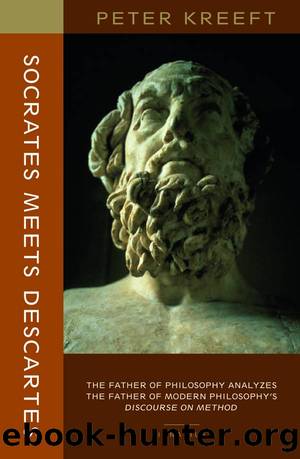
Author:Peter Kreeft [Kreeft, Peter]
Language: eng
Format: epub
Tags: Spiritual & Religion
ISBN: 9781586171889
Publisher: Ignatius Press
Published: 2011-03-29T06:00:00+00:00
11
Descartesâ Mathematicism
SOCRATES: Before we explore your third chapter, which contains four moral principles, there is one other matter I should like to question. You say that
[DM 2, para. 12]
there being but one truth for each thing, anyone who finds it knows as much as one can know about that thing. . . . For example, a child given lessons in arithmetic, having made one addition in accordance with its rules, can be assured of having found everything the human mind can find bearing on the sum he has examined.
I grant you that the method used in the mathematical sciences does yield this result, but do you say that this method will yield the same result in the other sciences and even in philosophy? If so, I have some questions about this claim. If not, what is the point of your example from arithmetic, if not to exemplify a more general principle?
DESCARTES: I do claim that, Socrates. And I am surprised that you question it. Surely every proposition is either true or false, whether its content is numbers or anything else; and we either know that this is true or we do not. What do you question?
SOCRATES: I question whether this is the only thing you mean by âknowâ?
DESCARTES: I suppose you could use the word âknowâ to refer to modes of awareness that are not scientific, not methodological, not logicalâan intuitive sense, for instance. But I would not call that âknowledgeâ.
SOCRATES: But about scientific knowledge that proceeds by strict logical methodâdo you claim that all such knowledge falls under your principle?
DESCARTES: I do.
SOCRATES: So do you mean to say that when you know that all men are mortal, and a five-year-old child also knows that all men are mortal, the two of you know exactly the same thing?
DESCARTES: Indeed.
SOCRATES: And that you do not know more than he does?
DESCARTES: That is exactly what I say.
SOCRATES: Because both of you know the simple fact that it is true that all men are mortal?
DESCARTES: Yes. You see my point, Socrates. What is there to question in it?
SOCRATES: Do you not understand what you mean more than the child does? Do you not have a clearer and more adequate concept of âmanâ and of âmortalâ than he has?
DESCARTES: Yes, of course.
SOCRATES: But you say you know no more than the child does.
DESCARTES: Yes.
SOCRATES: Then you must not classify that as âknowledgeâ.
DESCARTES: Classify what as knowledge?
SOCRATES: Knowing exactly what you mean by your terms when you utter a proposition.
DESCARTES: Thatâs right.
SOCRATES: But I think most people would call that âknowledgeâ. And here is a second thing most people would call âknowledgeâ that you apparently do not call âknowledgeâ: when you âknowâ that all men are mortal, you also know why this is so, and that it must be so. But a child may not know the reason, the why: that it is because an animal body is part of human nature. And even when he does, he may think, wrongly, that this is not
Download
This site does not store any files on its server. We only index and link to content provided by other sites. Please contact the content providers to delete copyright contents if any and email us, we'll remove relevant links or contents immediately.
| Anthropology | Archaeology |
| Philosophy | Politics & Government |
| Social Sciences | Sociology |
| Women's Studies |
The remains of the day by Kazuo Ishiguro(9086)
Tools of Titans by Timothy Ferriss(8493)
Giovanni's Room by James Baldwin(7436)
The Black Swan by Nassim Nicholas Taleb(7197)
Inner Engineering: A Yogi's Guide to Joy by Sadhguru(6836)
The Way of Zen by Alan W. Watts(6672)
The Power of Now: A Guide to Spiritual Enlightenment by Eckhart Tolle(5854)
Asking the Right Questions: A Guide to Critical Thinking by M. Neil Browne & Stuart M. Keeley(5832)
The Six Wives Of Henry VIII (WOMEN IN HISTORY) by Fraser Antonia(5558)
Astrophysics for People in a Hurry by Neil DeGrasse Tyson(5224)
Housekeeping by Marilynne Robinson(4504)
Double Down (Diary of a Wimpy Kid Book 11) by Jeff Kinney(4335)
12 Rules for Life by Jordan B. Peterson(4331)
Ikigai by Héctor García & Francesc Miralles(4311)
The Ethical Slut by Janet W. Hardy(4308)
Skin in the Game by Nassim Nicholas Taleb(4306)
The Art of Happiness by The Dalai Lama(4169)
Skin in the Game: Hidden Asymmetries in Daily Life by Nassim Nicholas Taleb(4051)
Walking by Henry David Thoreau(4002)
